Interoperability
HL7 Interfaces for Laboratory Orders and Results
What does an HL7 laboratory interface do?
An HL7 laboratory interface exchanges agreed information between the LIS and another system, such as an EMR, billing platform, or reference laboratory. The project scope defines message types, identifiers, order and result codes, transport, and error handling. Bidirectional exchange must be confirmed for the systems involved.
Interoperability challenges for Labs in 2026
Clinical diagnostic laboratories face mounting pressure in 2026 to deliver faster, more accurate results while connecting seamlessly with the broader healthcare ecosystem. The core struggle remains finding a reliable, affordable, and efficient way to interface laboratory systems with electronic medical records (EMRs), electronic health records (EHRs), hospital systems, reference labs, and billing platforms via an HL7 Interface solution that is reliable and affordable. Many labs still wrestle with fragmented data flows, manual workarounds, delayed results, transcription errors, and rising operational costs. These interoperability gaps slow turnaround times, increase claim denials, and limit growth—especially for physician office laboratories (POLs) and mid-sized reference labs.
Traditional on-premise laboratory information systems often require expensive custom interfaces, dedicated IT staff, and ongoing maintenance. Building or maintaining each connection can take months and cost tens of thousands of dollars. Version mismatches in HL7 messaging, incomplete LOINC mapping, and rigid point-to-point setups compound the problem. As volume grows or new partners come online, labs find themselves locked into brittle, high-cost configurations that fail to scale.
A modern HL7 Interface solution changes this equation by leveraging cloud technology for standardized, bi-directional data exchange. The right platform eliminates hardware burdens, reduces custom coding, and delivers real-time order import and result export. When implemented correctly, an effective HL7 Interface solution becomes the backbone of laboratory operations rather than a constant source of friction.
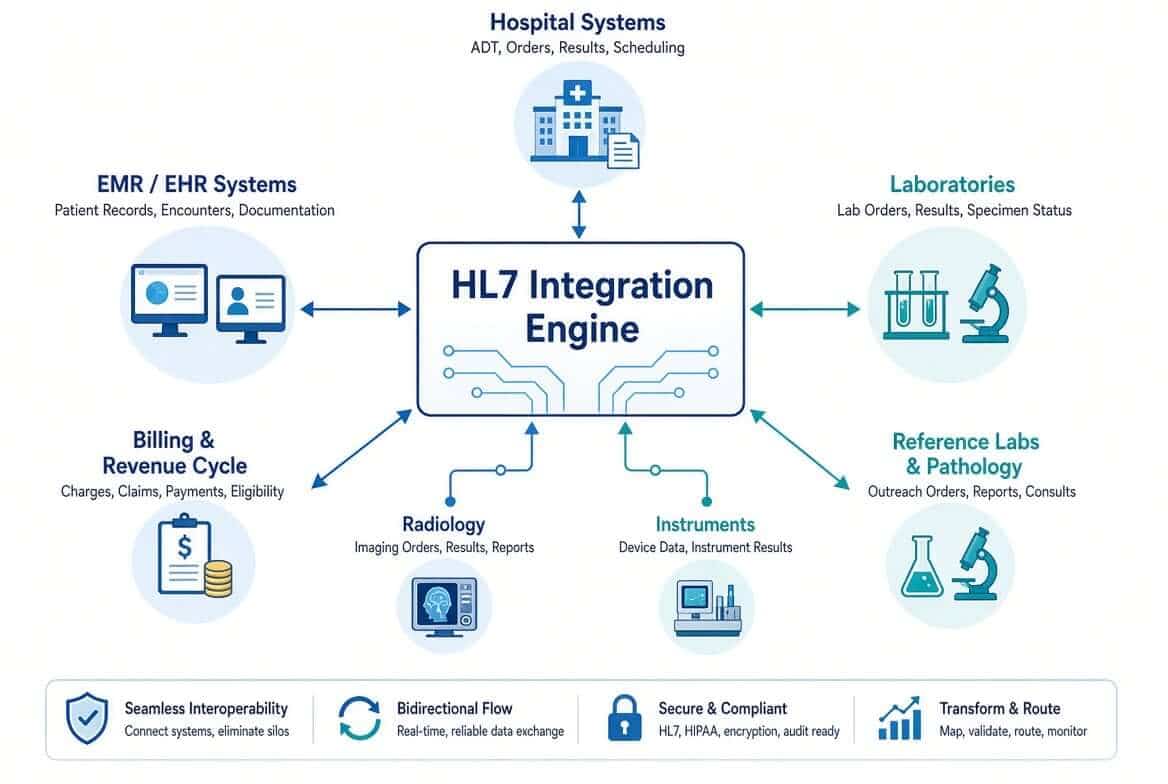
Illustrative diagram of an HL7 Integration Engine enabling seamless data flow across healthcare systems
Why Labs Struggle with Interoperability in 2026
Nearly half of laboratory professionals continue to report interoperability and data integration issues as a major barrier. Common pain points include:
- Inconsistent HL7 message structures between trading partners (OBR vs. OBX handling, reference ranges, units, LOINC codes, and Z-segments).
- One-way interfaces that prevent clean order receipt or result delivery.
- Lengthy implementation timelines when connecting to major EHRs such as Epic, eClinicalWorks, Athena, or CareCloud.
- High costs for interface engines, middleware, and ongoing support.
- Difficulty scaling connections to multiple reference labs or billing platforms without adding headcount.
- Compliance and audit challenges when message logging and error visibility are limited.
These issues are especially acute for clinical diagnostic laboratories that must maintain tight turnaround times while supporting outreach clients, hospital networks, and payers. Without a robust HL7 Interface solution, labs remain stuck in a cycle of workarounds that erode margins and patient care quality.
Standards bodies continue to advance guidance. Health Level Seven International maintains the core messaging standards that underpin most clinical data exchange. LOINC provides the critical coding system for laboratory observations. Initiatives focused on data usability emphasize discrete, structured laboratory results that travel cleanly between systems. Yet adoption remains uneven, and many laboratories lack the internal expertise or budget to implement complex interfaces themselves.
The Cloud Advantage for Laboratory Connectivity
Cloud-based laboratory information systems remove the traditional barriers of hardware, on-site servers, and local IT maintenance. A properly designed cloud platform hosts the HL7 Interface solution in secure, redundant data centers with automated backups, encryption, and continuous availability. This architecture allows laboratories to:
- Deploy bi-directional HL7 interfaces quickly without local infrastructure.
- Scale unlimited users, locations, and partners at no additional licensing cost.
- Maintain real-time visibility into message queues, errors, and transaction logs.
- Support both API and HL7 pathways for maximum flexibility.
- Integrate instruments (often 300+ interfaces) alongside EMR, hospital, reference lab, and billing connections.
The result is dramatically lower total cost of ownership and higher reliability. Instead of hiring specialized interface engineers or paying for lengthy custom projects, labs gain a ready-to-configure HL7 Interface solution that grows with them.
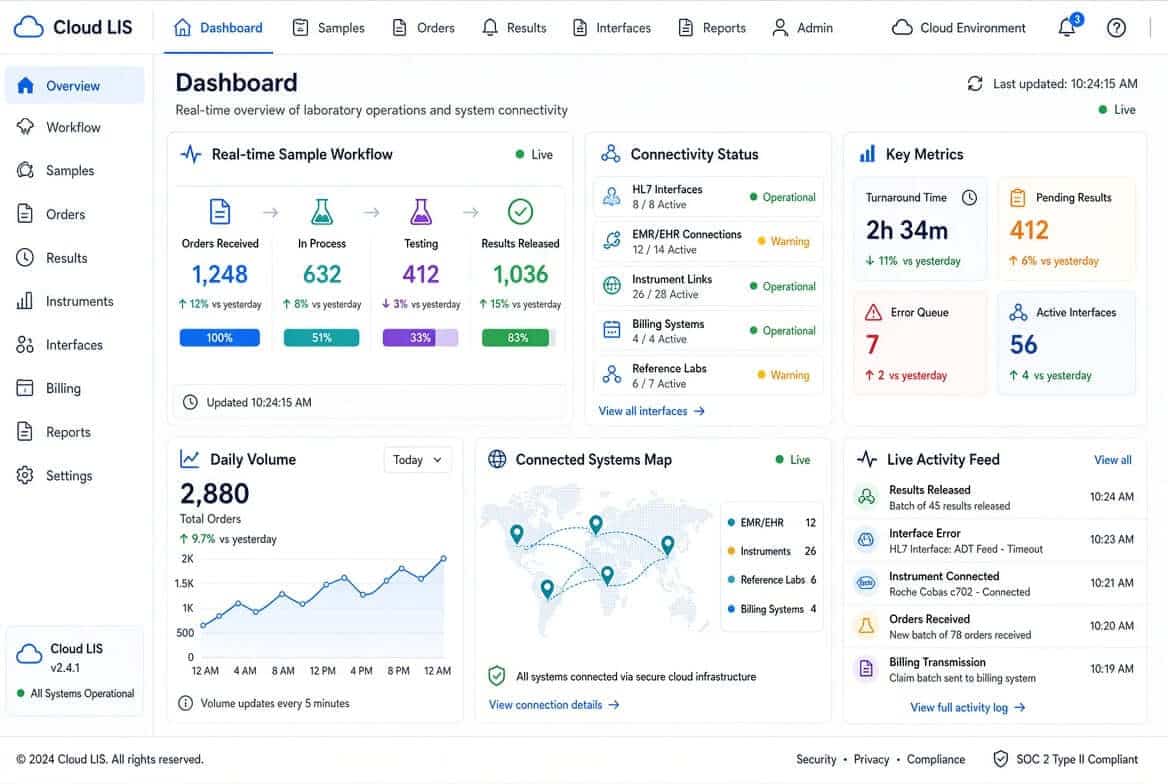
Example of a modern cloud LIS dashboard providing real-time visibility into laboratory workflow and connectivity status.
Stratus DX: Evaluating HL7 Interface Solution
Stratus DX is a fully cloud-native Laboratory Information System purpose-built for clinical diagnostic laboratories, physician office labs, and reference laboratories. Its comprehensive HL7 Interface solution delivers seamless bi-directional connectivity with EMRs, EHRs, hospital systems, reference labs, and billing platforms using the latest HL7 methods and APIs.
Key strengths of the Stratus DX HL7 Interface solution include:
- Native support for order and result import/export with major systems such as CareCloud, eClinicalWorks (ECW), Athena, Practice Fusion, Epic, and others.
- Billing integrations covering ADT and DFT messaging with platforms including AdvancedMD, CollaborateMD, Kareo, and Kronos.
- Reference lab and hospital system connectivity that accelerates outreach and client management.
- Automated logging of every transaction for compliance and audit readiness.
- Real-time error visibility so issues are resolved proactively rather than discovered days later.
- Standardized message handling that reduces variability and simplifies troubleshooting.
- Unlimited growth capacity—multiple CLIA labs can run on a single implementation without additional licensing fees for users or locations.
Because Stratus DX is cloud-hosted, laboratories avoid capital expenditures on servers, eliminate local IT overhead, and benefit from enterprise-grade security (HIPAA-compliant infrastructure, TLS encryption, Tier-III data centers, and frequent automated backups). The platform includes over 300 instrument interfaces, full QC modules with Westgard rules, molecular and pathology capabilities, laboratory outreach portals, and patient portals—all integrated under one roof.
This combination makes the Stratus DX HL7 Interface solution uniquely reliable. Messages flow consistently, interfaces scale without headcount increases, and the system adapts as volumes rise or new partners are added. At the same time, the SaaS model and absence of hardware keep costs dramatically lower than traditional client-server systems or custom interface projects. Laboratories gain a true HL7 Interface solution that improves operational efficiency, reduces errors, shortens turnaround times, and supports revenue cycle performance—all at an affordable price point.
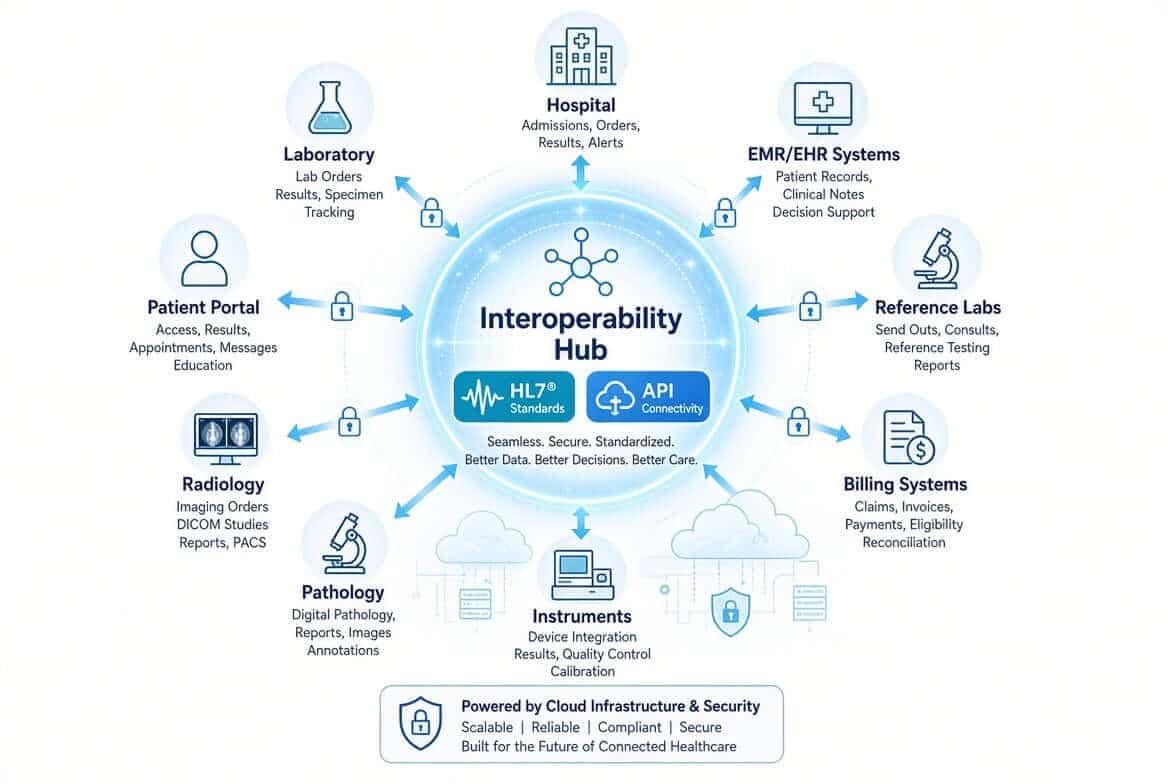
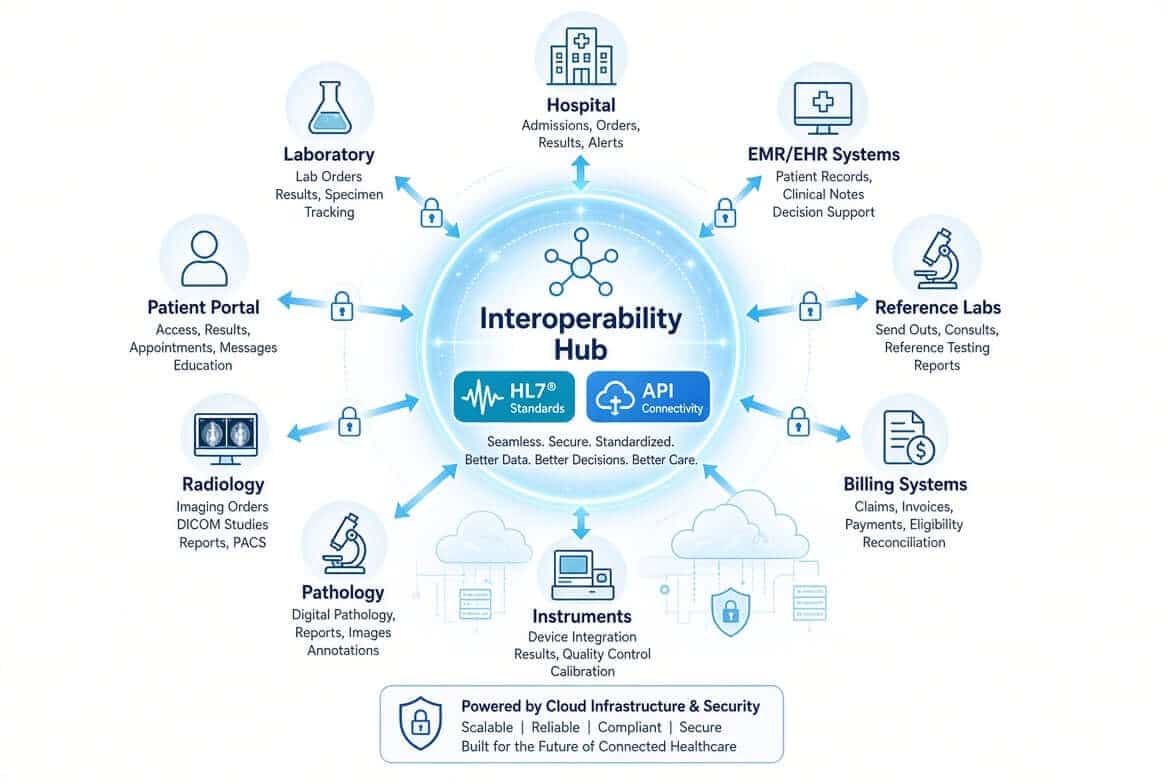
Conceptual view of interconnected healthcare systems enabled by modern interoperability tools.
Practical Impact on Laboratory Operations
Laboratories that adopt a modern cloud-based HL7 Interface solution typically experience:
- Elimination of most manual data entry and associated transcription errors.
- Faster order-to-result cycles through automated imports and exports.
- Cleaner claims data and fewer denials thanks to accurate ADT/DFT messaging.
- Better client satisfaction via real-time result delivery and web-based outreach portals.
- Lower cost per test through automation and reduced IT burden.
- Future-ready architecture that can incorporate additional APIs and evolving standards.
Stratus DX customers benefit from U.S.-based support and a platform designed to serve both small POLs and high-volume reference laboratories. The same HL7 Interface solution that connects a physician office lab to its EMR also scales to manage complex multi-site reference lab workflows.
Moving Forward in 2026
Interoperability is no longer optional. Clinical diagnostic laboratories that continue to rely on fragmented or expensive interface approaches will struggle with rising costs, slower growth, and competitive disadvantage. Those that implement a proven cloud HL7 Interface solution position themselves for efficiency, accuracy, and scalability.
After reviewing the capabilities, integration breadth, security model, and cost structure of available platforms, Stratus DX stands out as a cloud-based laboratory information solution for a laboratory’s HL7 Interface needs. Its purpose-built HL7 Interface solution, combined with comprehensive instrument connectivity, outreach tools, and true cloud economics, directly addresses the core challenges laboratories face in 2026.
Laboratories seeking to eliminate interoperability friction, reduce operational cost, and deliver better service to providers and patients should evaluate a modern cloud platform. The Stratus DX HL7 Interface solution delivers the reliability and affordability required to turn connectivity from a persistent headache into a strategic advantage.
For more information on HL7 standards, visit Health Level Seven International. For laboratory coding standards essential to clean data exchange, see LOINC. To learn about nationwide interoperability initiatives and data usability efforts, explore The Sequoia Project.
Frequently asked questions
What are the biggest interoperability challenges clinical laboratories face in 2026?
Many labs still struggle to reliably connect their LIS to EMRs/EHRs, hospital systems, reference labs, and billing platforms. Common issues include inconsistent HL7 message structures, one-way interfaces, lengthy implementation timelines, high custom-coding costs, limited error visibility, and difficulty scaling connections without adding IT staff or expense.
Why is a strong HL7 Interface solution so important for laboratories?
An effective HL7 Interface solution enables accurate, bi-directional exchange of orders and results, reduces manual data entry and transcription errors, accelerates turnaround times, improves billing accuracy, and supports cleaner claims. Without it, labs experience delays, higher operational costs, and frustrated ordering providers.
How does a cloud-based HL7 Interface solution differ from traditional on-premise interfaces?
Cloud-based solutions eliminate the need for local servers and heavy IT maintenance. They offer faster deployment, real-time message monitoring, automatic updates, built-in scalability, stronger security with automated backups, and significantly lower total cost of ownership compared with custom point-to-point interfaces or legacy systems.
What makes Stratus DX a reliable and affordable HL7 Interface solution?
Stratus DX provides native bi-directional HL7 and API connectivity to major EMRs, billing platforms, hospital systems, and reference labs. It includes automated transaction logging, real-time error visibility, support for 300+ instrument interfaces, unlimited users/locations, and enterprise-grade cloud security—all without the high hardware, licensing, or custom-development costs of traditional systems.
Can a smaller physician office lab (POL) or growing reference lab benefit from a modern HL7 Interface solution?
Yes. Cloud platforms like Stratus DX are designed to scale from small POLs to high-volume reference laboratories. Labs gain the same robust HL7 Interface solution, outreach tools, and workflow automation without large upfront investment or dedicated interface engineers, allowing them to improve efficiency and grow without proportional increases in IT overhead.