Toxicology LIS Requirements: A Buyer's Checklist for Pain Management and Drug Testing Labs
What should a toxicology LIS do?
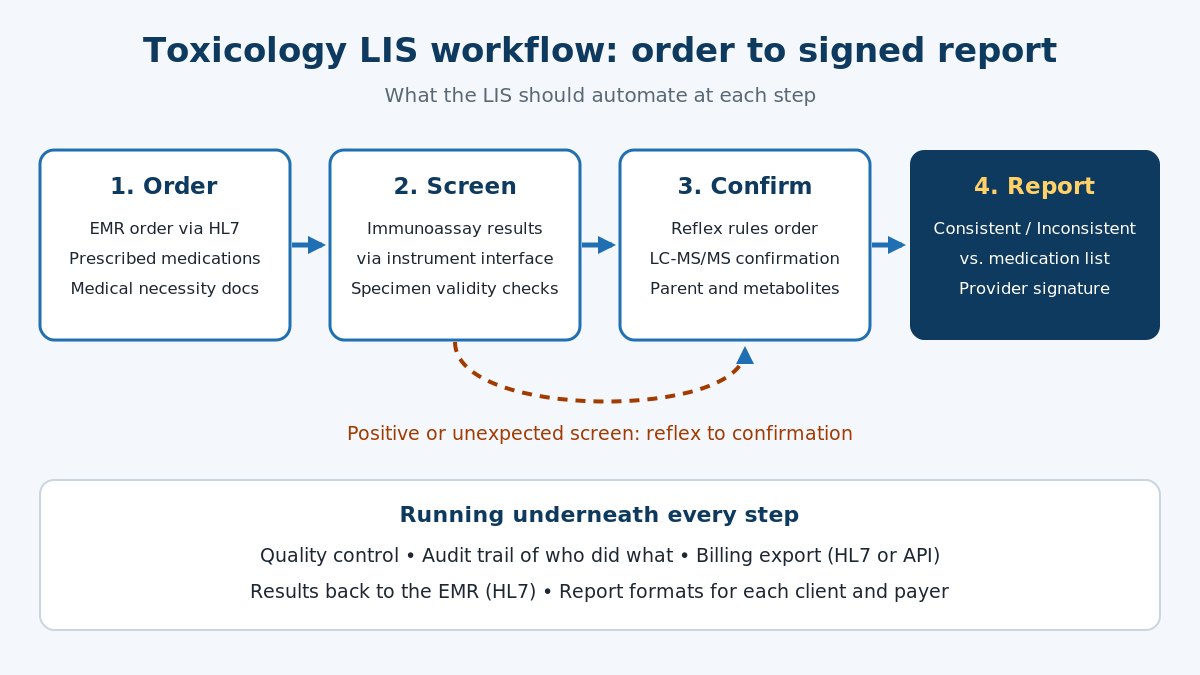
A toxicology LIS has to do more than store results. It should support configurable reflex testing from immunoassay screening to LC-MS/MS confirmation when clinically appropriate and authorized, compare results with the patient's prescribed medications, record specimen validity, and return "Consistent" or "Inconsistent" flags to the ordering provider's EMR for clinical review. If a system can't handle those four jobs without spreadsheets or manual re-entry, it isn't built for toxicology.

This checklist is for lab directors, toxicologists and operations leaders at high-complexity reference and specialty toxicology labs, moderate-complexity labs running immunoassay drug screens, and pain management or addiction medicine practices with an in-house lab. Use it to compare vendors, prepare demo questions, or check whether your current toxicology lab software is holding you back.
Evaluating a toxicology LIS? See the StratusDX toxicology module or get an instant LIS quote. StratusDX has $0 setup, $0 training and $0 for unlimited user licenses.
1. Why Toxicology Labs Outgrow a General Clinical LIS
A general clinical LIS is designed around a simple pattern: one order, one test, one result, one reference range. Toxicology breaks that pattern in several ways:
- One order becomes many tests. A single urine drug test can start as a screening panel and branch into confirmations for individual drug classes, each with several analytes.
- A "normal" result depends on the patient. A positive oxycodone result is expected for a patient prescribed oxycodone and a red flag for one who isn't. Reference ranges alone can't tell the difference.
- Results need interpretation, not just values. Providers want to know whether the results match the prescribed medications, not read a long list of cutoffs and concentrations.
- Documentation drives reimbursement. Payers expect medical necessity documentation for drug testing, and denials are costly when it's missing.
- The instruments are different. Mass spectrometry systems produce batch output with many analytes per sample, often through middleware.
When a lab forces this work into a general LIS, staff end up managing reflex lists by hand, keying medication lists from paper requisitions and writing interpretive comments one report at a time. That's slow, and every manual step is a chance for error.
2. Screening, Reflex and Confirmation Workflow (Immunoassay to LC-MS/MS)
Most toxicology programs follow a two-step model. A fast, lower-cost immunoassay screen runs first, often on an automated chemistry analyzer. Presumptive positives, and sometimes unexpected negatives, then go to a definitive method such as LC-MS/MS for confirmation and quantitation. The LIS should run that whole path.
Reflex rules based on screening results
Look for configurable rules that trigger the appropriate confirmation by drug class and cutoff when supported by the provider's order, patient-specific medical necessity and applicable payer requirements. Ask whether rules can differ by client or panel, and whether they distinguish reference-laboratory workflows from point-of-care testing. Automatic confirmation of every positive screen is not appropriate in every setting.
Batching and worklists for confirmation
Confirmation testing is usually batched. The LIS should build worklists for the mass spectrometry run, track each sample's position, and show what's pending so nothing waits in the queue unnoticed.
Definitive-only and custom panels
Some providers order definitive testing directly without a screen. Your LIS should support screen-only, screen-plus-reflex and definitive-only orders on the same requisition workflow.
In StratusDX, pain management and toxicology labs set up reflex rules based on screening results, so an authorized confirmation can be triggered without a technologist re-entering the order. Labs should validate these rules against their clinical protocols, ordering requirements and applicable coverage policies.
3. Medication Consistency and Parent/Metabolite Reporting
Medication consistency reporting is the feature that separates a true toxicology LIS from a general one. The goal is a report that tells the provider, at a glance, whether the results fit the patient's prescriptions.
A medications library linked to tests
The LIS needs a medication library where each drug is mapped to the analytes that should appear when the patient takes it, including the parent drug and its expected metabolites. For example, a prescribed drug may be expected to show a specific metabolite, and finding the metabolite without the parent (or the reverse) can be clinically meaningful. Ask who maintains the library and how quickly you can add a new medication.
Capturing the prescribed medication list
The medication list must arrive with the order, ideally from the EMR rather than retyped from a paper requisition. Check whether the vendor can capture prescribed dosage as well as the drug name for clinical context. Urine drug concentrations should not be used to determine the dose taken or adherence to a prescribed dosage regimen.
Consistent and Inconsistent flagging
The system should compare results with the medication list and flag each finding as consistent or inconsistent: an expected drug detected, an expected drug not detected, or an unexpected drug detected. The provider should see those flags on the report summary, not have to work them out. These are decision-support flags, not proof of adherence or misuse: collection timing, metabolism, specimen dilution and test limitations can affect whether a drug or metabolite is detected. Unexpected findings need clinical review and, when appropriate, definitive testing.
StratusDX includes a medications library linked to tests with rules correlations, correlated dosage with medications, and "Consistent" and "Inconsistent" flagging on lab reports. Labs can also apply "Normal" and "Abnormal" or other flagging rules to medication protocols, choose from more than 20 pain-related report formats, and review results alongside medications with provider signatures.
4. Specimen Validity, Chain of Custody and Medical Necessity Documentation
Drug test results are only as defensible as the specimen and paperwork behind them. Your LIS evaluation should cover three areas.
Specimen validity
Many labs run validity tests such as creatinine, pH, specific gravity and oxidant checks to detect dilute, substituted or adulterated urine. Ask how the LIS records those results, whether it flags an invalid specimen automatically, and how that status appears on the final report. Under CLIA, a test report must include information about the condition and disposition of specimens that don't meet the lab's acceptability criteria (42 CFR 493.1291).
Chain of custody
Clinical pain management testing usually doesn't require forensic chain of custody, but some labs also serve employers, courts or treatment programs that do. Federal workplace drug testing follows the HHS Mandatory Guidelines described on SAMHSA's Drug-Free Workplace Programs pages. If you offer that kind of testing, ask each vendor exactly how custody steps, handoffs and signatures are recorded, and confirm it in the demo rather than on a feature list.
Medical necessity documentation
Payers expect the ordering provider's documentation to support each drug test. A toxicology LIS should capture diagnosis codes and supporting information at order entry and keep it with the requisition. StratusDX labs can use the Assessment Forms tool for opioid risk screening with instruments such as SOAPP-R, ORT and PMQ, with automated low, moderate or high risk scoring, CMS-aligned testing frequency and exportable reports for billing and audit support. StratusDX also offers patient and provider signatures on toxicology reports and requisitions, and an integrated medical necessity documentation solution through its partnership with Cellarian. For how documentation differs from LIS security, see our post on urine drug testing documentation and LIS security.
5. Instrument, EMR and Billing Interfaces
Interfaces decide how much manual work your staff does every day. A toxicology lab needs three kinds.
Instrument interfaces for screening and LC-MS/MS
Ask whether the vendor already has instrument interfaces for your screening analyzers and your LC-MS/MS systems, and whether they connect directly or through middleware. Mass spectrometry results often pass through middleware before reaching the LIS, so confirm the vendor has done that before. StratusDX has a library of instrument interfaces for toxicology instrumentation, including automated screening, LCMS confirmations and LCMS/MS confirmations, and supports LCMS and auto-chemistry interfaces with Instrument Manager.
EMR interfaces (HL7)
Orders, demographics and medication lists should come in from the provider's EMR, and results should go back as discrete data and a readable report. These software-to-software connections use HL7 interfaces. StratusDX interfaces with virtually any EMR, from enterprise health systems to single-site practices.
Billing interfaces
Toxicology billing depends on accurate codes, documentation and payer information. StratusDX offers API and HL7-based ADT and DFT import and export with billing platforms, and add-on modules such as insurance eligibility verification before samples are run. Labs that also offer pharmacogenomics can use pharmacogenomic interfaces for Coriell and Translational Software.
6. Toxicology LIS Requirements Checklist
Use this checklist in vendor demos. Ask each vendor to show the feature live with your own panels, not describe it.
| Area | Requirement | Ask the vendor |
|---|---|---|
| Ordering | Electronic orders from the EMR with prescribed medications, diagnosis codes and panel selection | Can the medication list and dosage come in through the HL7 order? |
| Reflex rules | Authorized, clinically appropriate confirmation orders from screening results, configurable by drug class, client and panel | Show an authorized confirmation triggered under the lab's validated rules. |
| Confirmation workflow | Worklists and batching for LC-MS/MS; screen-only, reflex and definitive-only orders | How are pending confirmations tracked? |
| Medication consistency | Medication library mapped to parent drugs and metabolites; Consistent/Inconsistent flags | Who maintains the library? How fast can we add a drug? |
| Specimen validity | Validity results recorded and invalid specimens flagged on the report | How does an invalid specimen appear to the provider? |
| Chain of custody | Custody steps and signatures recorded, if you offer forensic or workplace testing | Show the custody record for one specimen. |
| Medical necessity | Documentation captured at order entry and kept with the requisition; risk assessments | Can documentation be exported for audits and appeals? |
| Instrument interfaces | Screening analyzers and LC-MS/MS, directly or through middleware | Which of our exact instruments are already interfaced? |
| EMR and billing | HL7 results to the EMR; HL7 or API billing export; eligibility checks | Which EMRs and billing systems are live today? |
| Reporting | Multiple toxicology report formats, interpretive summaries, provider signatures | Can each client choose its own report format? |
| Quality and security | QC tools across locations, audit trail, encryption, BAA | Where is data hosted, and will you sign a BAA? |
| Implementation and cost | Clear timeline, data migration plan, predictable pricing | What are setup, training and per-user fees? |
7. Cost and Implementation: Subscription vs Legacy System
Many toxicology labs run on older client-server systems that were customized years ago. They still work, but every change to a panel, rule or interface can mean a service ticket, and the lab carries the cost of servers, backups and upgrades. A subscription cloud LIS moves that work to the vendor.
When you compare costs, look at the full picture rather than the monthly fee alone:
- Upfront fees. StratusDX has Three Zeros: $0 setup, $0 training and $0 for unlimited user licenses.
- Hosting and security. StratusDX is a cloud LIS hosted on AWS and Liquid Web, with encryption in transit and at rest. A BAA is available on request.
- Implementation time. Most labs switch to StratusDX in 1-4 weeks. A toxicology lab's timeline depends mostly on the number of instrument and EMR interfaces and how many panels and medication rules need to be built.
- Historical data. Past results can be exported to PDF, so you keep access to prior reports after the move.
- Support. StratusDX standard support runs Monday through Friday, 8 AM to 7 PM ET, with 24/7 support available as a paid add-on.
Planning a move from a legacy system? Our step-by-step guide on how to switch LIS systems covers data migration, validation and go-live. Reference labs running toxicology alongside other specialties can also review StratusDX for reference laboratories.
Ready to compare? Get an instant LIS quote, see the toxicology module or schedule a demo. Call 888-585-5695 or email info@stratusdx.com.
8. FAQ
What features should a toxicology LIS have?
A toxicology LIS should have configurable reflex rules from screening to confirmation that support authorized, clinically appropriate testing, instrument interfaces for immunoassay analyzers and LC-MS/MS, a medication library with Consistent and Inconsistent flagging for clinical review, specimen validity tracking, medical necessity documentation, HL7 interfaces to EMRs, billing exports and multiple toxicology report formats.
Can an LIS interface with LC-MS/MS instruments?
Yes. A toxicology LIS should receive LC-MS/MS confirmation results through an instrument interface, either directly or through middleware. StratusDX has instrument interfaces for LCMS and LCMS/MS confirmations and supports LCMS interfaces with Instrument Manager.
How does an LIS flag results inconsistent with prescribed medications?
The LIS links each prescribed medication to its expected analytes and metabolites, then compares the results with the medication list and flags missing expected drugs or detected unexpected drugs as "Inconsistent" for clinical review. These flags do not by themselves establish adherence or misuse; collection timing, metabolism, specimen dilution and test limitations can affect results.
How long does it take to implement a toxicology LIS?
Most labs switch to StratusDX in 1-4 weeks. Toxicology labs with many instrument interfaces, EMR connections, panels and medication rules should plan time for building and validating that setup before go-live.
Is toxicology a separate module in StratusDX?
StratusDX offers pain management and toxicology capabilities within its cloud LIS, including the medications library, reflex rules, consistency flagging and toxicology report formats, alongside add-on modules such as Assessment Forms and patient and provider signatures. Contact StratusDX for pricing for your lab's setup.