
CLIA Inspection Checklist: Records to Prepare and How Your LIS Helps
What is a CLIA inspection checklist?
A CLIA inspection checklist is a list of the records and evidence a lab should have ready before surveyors arrive: the CLIA certificate, personnel qualifications and competency records, the procedure manual, quality control (QC) and calibration records, proficiency testing (PT) results and patient test reports. Inspections rarely fail because a lab is doing poor work. More often, a record can't be found, isn't signed, or doesn't show what was done when something went wrong. StratusDX is a cloud LIS (laboratory information system), and this guide shows what to prepare and how an LIS keeps it ready.

This guide is for lab directors, lab managers and compliance owners at CLIA-waived, moderate-complexity and high-complexity labs, including physician office labs (POLs), urgent care, and reference and specialty labs. If you're not sure which rules apply to your test menu, start with our guide to waived, moderate and high complexity labs.
Want QC and reports that are inspection-ready every day? See StratusDX QC and reporting or get an instant LIS quote. StratusDX has $0 setup, $0 training and $0 for unlimited user licenses.
1. What Happens During a CLIA Survey
The Clinical Laboratory Improvement Amendments (CLIA) regulations are in 42 CFR Part 493, and CMS runs the program with state survey agencies. Who inspects your lab depends on your certificate:
- Certificate of Compliance. The state survey agency surveys the lab for CMS, generally about every two years.
- Certificate of Accreditation. An accrediting organization approved by CMS, such as COLA, CAP or The Joint Commission, inspects the lab against its own standards, generally on a two-year cycle. CMS may also perform validation surveys.
- Certificate of Waiver or PPM. These labs are not on the routine survey cycle but can still be visited, including after a complaint.
Surveyors follow the CMS guidance in Appendix C of the State Operations Manual. A typical survey includes an entrance meeting, a tour, record review, interviews with staff and observation of testing from specimen receipt to reporting, then an exit conference. Under 42 CFR 493.1773, the lab must make its records and data "accessible and retrievable within a reasonable time frame during the course of the inspection." Deficiencies are written up on a Statement of Deficiencies (Form CMS-2567) or the accreditor's report, and the lab responds with a plan of correction.
2. Administrative Records: CMS-116, CMS-209 and Ownership
Start with the paperwork that defines your lab:
- CLIA certificate. A current certificate for each site, plus any state license and your accreditation certificate if you are accredited.
- CMS-116. Your CLIA application on file, with the director, address, certificate type and test menu matching what you actually do today.
- CMS-209. The Laboratory Personnel Report surveyors use to list everyone who performs or oversees non-waived testing, with their roles. Keep it current so it matches your personnel files.
- Ownership and changes. Labs with a Certificate of Compliance must notify CMS or its designee within 30 days of a change in ownership, name, location or director (and technical supervisor for high-complexity labs), and within 6 months of adding a specialty or changing test methods (42 CFR 493.51).
- Test menu and volume. A current list of tests by complexity, with the instruments and methods used.
3. Personnel: Qualifications, Training and Competency Records
Personnel findings are common because the records live in many places. For each person in a CLIA role (director, technical consultant or technical supervisor, clinical consultant, general supervisor and testing personnel, depending on complexity), keep:
- Proof of education and qualifications, such as diplomas, transcripts and licenses where your state requires them.
- A written delegation of duties signed by the lab director.
- Training records for each test system the person performs.
- Competency assessments. For non-waived testing, CLIA requires assessment at least semiannually during a person's first year of testing and at least annually after that, covering the six required elements: direct observation of testing, monitoring of result recording and reporting, review of worksheets, QC, PT and maintenance records, direct observation of maintenance and function checks, testing of previously analyzed or blind samples, and problem-solving skills.
CMS updated some personnel qualification rules in recent years, so check the current text of Subpart M and your accreditor's checklist when you hire or promote staff.
4. QC, Calibration and Levey-Jennings Charts
QC records show surveyors that each test system was working before patient results went out. Under 42 CFR 493.1256, unless the lab uses an approved alternative such as an Individualized Quality Control Plan (IQCP), each quantitative procedure needs two control materials of different concentrations at least once each day patient specimens are tested, and each qualitative procedure needs a negative and a positive control. Calibration verification must be done at least every 6 months and when certain events occur, such as a complete change of reagents or major preventive maintenance (493.1255).
Surveyors usually ask to see:
- Control results with lot numbers, expiration dates and the acceptable ranges for each lot.
- Levey-Jennings charts and the Westgard rules the lab applies.
- Documented corrective action for every out-of-range control, including what happened to patient results run since the last acceptable QC.
- Calibration, calibration verification and maintenance records, plus temperature logs for refrigerators, freezers and incubators.
- Evidence that a supervisor or director reviewed the QC.
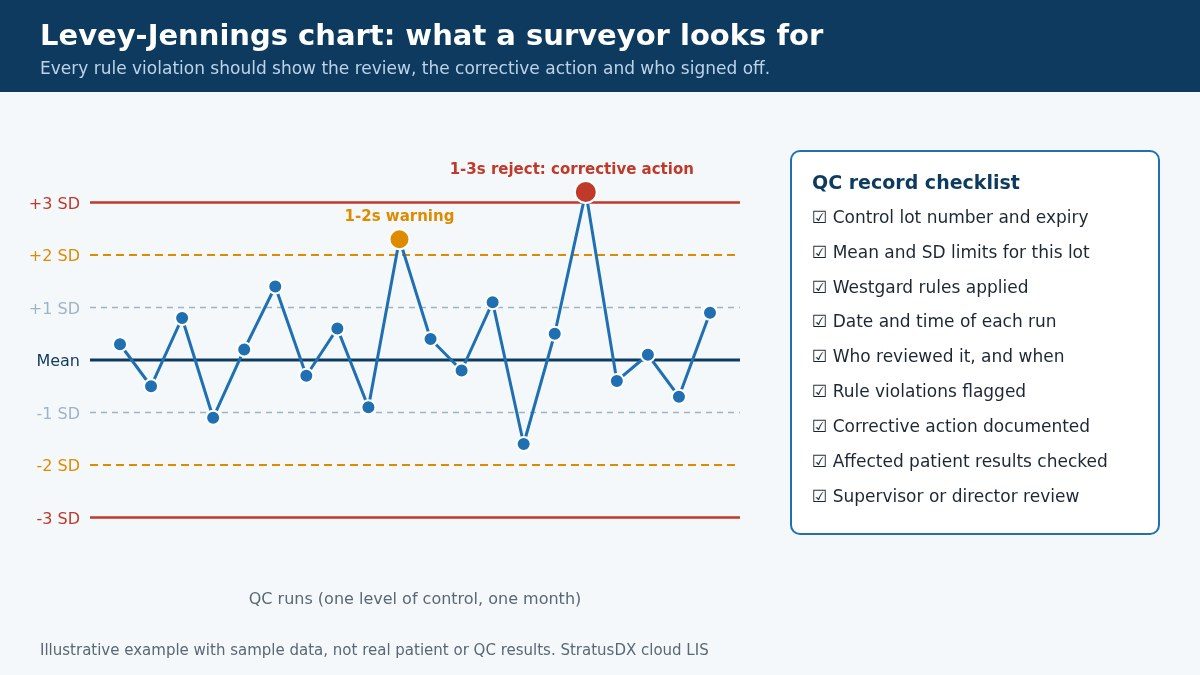
When an analyzer sends QC results over an instrument interface, they arrive in the LIS with the run date and time already attached, which cuts transcription errors. Learn how analyzers connect in our post on ASTM instrument interfaces vs HL7 interfaces.
5. Proficiency Testing Records and Corrective Actions
Labs doing non-waived testing must enroll in a CMS-approved PT program for each specialty and subspecialty they're certified for, and test PT samples the same way as patient specimens (42 CFR 493.801). For each PT event, keep:
- The PT program's instructions, your submitted results and the graded report.
- The signed attestation that the samples were tested like patient specimens.
- Your review of every result, with an investigation and corrective action for any unacceptable score.
- For tests not covered by an approved PT program, documentation that you verified their accuracy at least twice a year (493.1236).
Never send PT samples to another lab or discuss PT results with other labs before the deadline. Surveyors treat this seriously, and the penalties can be severe.
6. Procedures, Document Control and Patient Test Reports
Your procedure manual must cover every test the lab performs, and procedures and changes must be approved, signed and dated by the current lab director before use (42 CFR 493.1251). Keep retired procedures with their dates of initial use and discontinuance. Surveyors also check package inserts, safety data sheets and maintenance logs. Our guide to cloud LIS document management covers how to keep them organized.
For patient test reports, surveyors check that the report includes the required elements, such as patient name and identifier, the lab's name and address, the test performed, the report date, results with units, reference intervals and the condition of any specimen that didn't meet acceptability criteria. They also check that corrected reports keep the original and the correction, and that critical values were called and documented. Keep test requisitions with each report.
7. How Your LIS Keeps Two Years of Records Inspection-Ready
Most CLIA records must be kept for at least 2 years, and pathology reports for 10 (see our guide to CLIA record retention requirements). An LIS doesn't replace your quality program, but it keeps the evidence in one place, so pulling records takes minutes, not days.
- Quality control. StratusDX QC shows results as soon as the instrument finishes, with flags, warnings, Levey-Jennings charts and Westgard rules. A built-in audit trail shows the lab director when each result was reviewed and by whom. Reports include Levey-Jennings and Westgard failure reports, control summaries, daily control reports, corrective action reports and QC lot control.
- Documents. The Document Management module stores SOPs, package inserts, safety data sheets, maintenance logs and calibration procedures in the cloud, with security-controlled editing. Technical consultants can review SOPs remotely.
- Reports. The Reports Suite has over 125 lab management and results reports, including specimen audit, turnaround time and security reports, so you can retrieve patient reports and audit trails by patient, date or accession.
- Hosting. StratusDX always hosts its cloud LIS on AWS and Liquid Web, with encryption in transit and at rest and redundant backups. It is never installed on your servers. Analyzers connect through Instrument Manager, a lightweight local app that securely transports data to StratusDX's cloud. Instrument Manager is not the LIS.
Printable CLIA inspection checklist
| Area | Have ready | Where it can live |
|---|---|---|
| Administrative | CLIA certificate, state license, accreditation certificate, CMS-116, CMS-209, ownership and director change notices, test menu by complexity | Document management |
| Personnel | Qualifications, delegation of duties, training, competency assessments (semiannual in year one, then annual) | Personnel files; document management |
| QC and calibration | Daily QC, lot numbers and ranges, Levey-Jennings charts, Westgard rule violations, corrective actions, calibration verification, maintenance and temperature logs | LIS QC module and reports |
| Proficiency testing | Enrollment, results, graded reports, attestations, reviews and corrective actions, twice-yearly accuracy checks for non-PT tests | Document management |
| Procedures | Signed and dated procedure manual, retired procedures with dates, package inserts, safety data sheets | Document management |
| Patient testing | Requisitions, final and corrected reports, critical value documentation, specimen rejection records, audit trails | LIS reports and audit trail |
StratusDX standard support runs Monday through Friday, 8 AM to 7 PM ET, with 24/7 support available as a paid add-on. Most labs switch to StratusDX in 1-4 weeks.
Get inspection-ready QC and reports: see StratusDX QC and reporting, get an instant LIS quote or schedule a demo. Call 888-585-5695 or email info@stratusdx.com.
8. FAQ
What do CLIA inspectors look at during a survey?
Surveyors review whether the lab meets the CLIA regulations in 42 CFR Part 493 across the whole testing process. They typically look at the lab's certificate and test menu, personnel qualifications and competency records, the procedure manual, quality control and calibration records, proficiency testing results and corrective actions, and patient test reports. They also tour the lab, watch staff test specimens and interview personnel.
How often are CLIA labs inspected?
Labs with a Certificate of Compliance are generally surveyed about every two years by the state survey agency on behalf of CMS. Labs with a Certificate of Accreditation are inspected by their accrediting organization, such as COLA, CAP or The Joint Commission, on that organization's cycle, which is also generally every two years. CMS can also perform validation surveys of accredited labs, and any lab can be visited after a complaint.
What records must be available for a CLIA inspection?
Have your CLIA certificate and application information, personnel qualifications, training and competency records, the signed procedure manual, QC, calibration and maintenance records, proficiency testing records with corrective actions, test requisitions and patient test reports ready. Under 42 CFR 493.1773, records must be accessible and retrievable within a reasonable time frame during the inspection. Most of these records must be kept at least 2 years; see our CLIA record retention guide for the exceptions.
Can QC records and Levey-Jennings charts be kept electronically in the LIS?
Yes. CLIA allows electronic records as long as they are accurate, complete and retrievable. An LIS with built-in QC can store control results, apply Westgard rules, display Levey-Jennings charts and keep an audit trail of who reviewed each result and when. Check your accreditor's requirements for electronic signatures and review documentation.
Are CLIA waived labs inspected?
Labs with a Certificate of Waiver are not on the routine two-year survey cycle, but CMS and state agencies can visit them, and they can be inspected after a complaint. Waived labs must follow the manufacturer's instructions for each test, so keep package inserts, QC that the manufacturer requires, and test records organized. If you also run moderate-complexity tests, the lab needs a Certificate of Compliance or a Certificate of Accreditation and is surveyed on the regular cycle.