
CLIA Record Retention Requirements: How Long Labs Must Keep Results, QC and Reports
How long does CLIA require labs to keep records?
Under CLIA, a lab must keep most records for at least 2 years: test requisitions, quality control (QC) and patient test records, proficiency testing (PT) records, and copies of test reports. Pathology test reports and histopathology slides must be kept for at least 10 years, and cytology slides for at least 5 years. These minimums come from 42 CFR 493.1105 and apply to non-waived (moderate- and high-complexity) testing. State law and your accreditor can require longer.

This guide is for lab directors, lab managers and compliance owners at CLIA-waived, moderate-complexity and high-complexity labs, including physician office labs (POLs), urgent care labs, and reference, pathology and specialty labs. StratusDX is a cloud LIS (laboratory information system), so we also cover the question we hear most from labs planning a change: what happens to our old results?
Planning a switch? Get an instant LIS quote. POL? See POL LIS cost. StratusDX has $0 setup, $0 training and $0 for unlimited user licenses.
1. CLIA Retention at a Glance
The table below summarizes the minimum retention periods in 42 CFR 493.1105. Treat these as floors, not targets. Confirm the full text on eCFR and check your state rules and accreditor before you set your own retention policy.
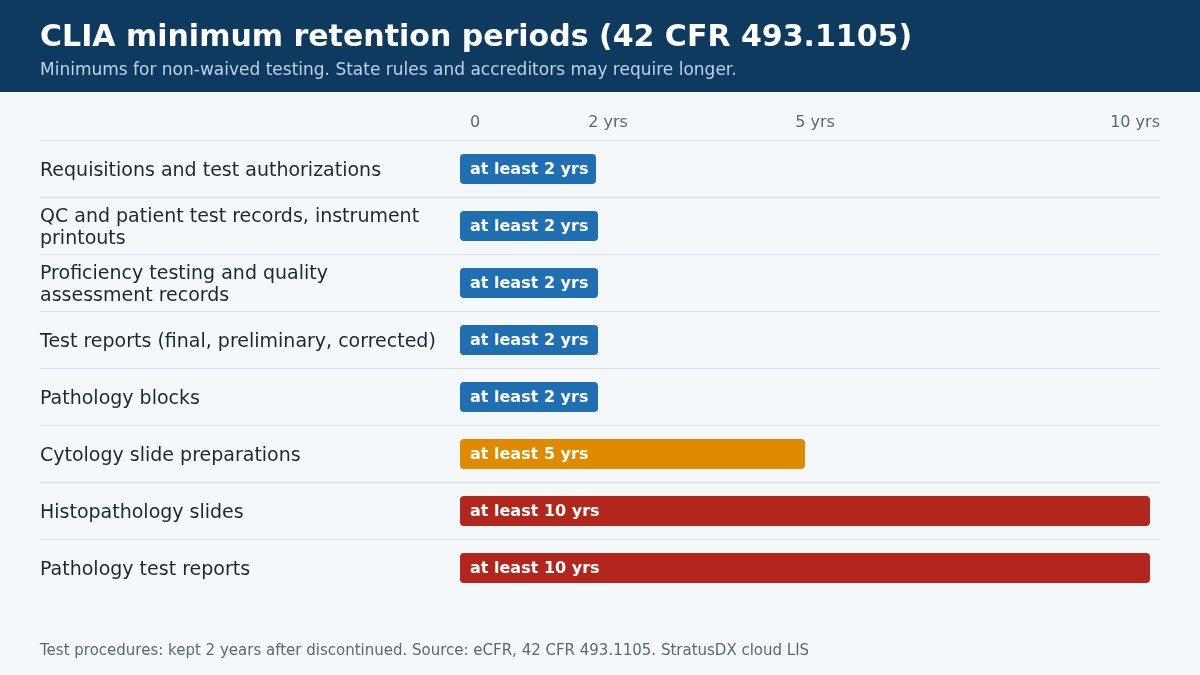
| Record type | Minimum retention under CLIA | Citation |
|---|---|---|
| Test requisitions and authorizations (including the patient chart if used as the requisition) | At least 2 years | §493.1105(a)(1) |
| Test procedures | At least 2 years after the procedure is discontinued (include dates of initial use and discontinuance) | §493.1105(a)(2) |
| QC and patient test records, including instrument printouts, and analytic systems records | At least 2 years | §493.1105(a)(3) |
| Test system performance specifications you establish or verify | For as long as you use the test system, but no less than 2 years | §493.1105(a)(3)(i) |
| Proficiency testing records | At least 2 years | §493.1105(a)(4) |
| Quality system assessment records | At least 2 years | §493.1105(a)(5) |
| Test reports (final, preliminary and corrected) | Retain or be able to retrieve a copy for at least 2 years after the date of reporting | §493.1105(a)(6) |
| Pathology test reports | At least 10 years after the date of reporting | §493.1105(a)(6)(ii) |
| Cytology slide preparations | At least 5 years from the date of examination | §493.1105(a)(7)(i)(A) |
| Histopathology slides | At least 10 years from the date of examination | §493.1105(a)(7)(i)(B) |
| Pathology specimen blocks | At least 2 years from the date of examination | §493.1105(a)(7)(ii) |
2. Test Reports, Requisitions and QC Records: The 2-Year Baseline
For most routine testing, the baseline is 2 years. That covers the records most labs generate every day:
- Requisitions and authorizations. Keep the order for at least 2 years. If the patient's chart or medical record serves as the requisition, the chart counts.
- QC and patient test records. This includes instrument printouts, where applicable, and records of analytic system activities such as calibration and maintenance covered by §§493.1252 through 493.1289.
- Proficiency testing and quality system assessment records. Keep each for at least 2 years.
- Test reports. Keep, or be able to retrieve, a copy of the original report, including final, preliminary and corrected reports, for at least 2 years after the date of reporting. Under §493.1291, reports must be maintained so they can be identified and retrieved in a timely way, and you must keep duplicates of both the original and the corrected report when an error is found.
Two details are easy to miss. Procedures are kept for 2 years after they are discontinued, not after they were written. And performance specifications you establish or verify must be kept as long as you use the test system, with a 2-year minimum.
3. Exceptions: Pathology Reports, Slides and Immunohematology
Pathology and blood bank records are where the longer clocks start:
- Pathology test reports: at least 10 years after the date of reporting.
- Histopathology slides: at least 10 years from the date of examination.
- Cytology slide preparations: at least 5 years from the date of examination.
- Pathology specimen blocks: at least 2 years from the date of examination.
- Tissue remnants: preserve until a diagnosis is made on the specimen.
- Immunohematology, blood and blood product, and transfusion records: CLIA points to specific provisions of 21 CFR 606.160. Read that regulation directly for the periods that apply to your lab.
If a lab closes, §493.1105(b) requires it to make provisions so that records, slides, blocks and tissue remain retained and available for the required time frames. Pathology labs that want to keep reports organized and retrievable can review the StratusDX pathology LIS page.
4. State Rules and Accreditor Requirements May Be Longer
CLIA sets minimums. Your state health department, your accreditor (such as CAP or COLA), payer contracts and your medical record or HIPAA policies may require longer retention. When two rules differ, the longer period generally governs what you should keep, so confirm the requirements that apply to your lab before you set or shorten a retention schedule.
What about waived labs?
The retention standard in §493.1105 is written for laboratories performing non-waived testing. Labs with a Certificate of Waiver must follow the manufacturer's instructions for each test and the certificate requirements in 42 CFR part 493, subpart B. Many waived labs still keep results for longer because of state rules, the patient's medical record requirements and good practice. If you run waived tests alongside moderate-complexity tests, apply the longer standard to the whole lab to keep your policy simple, and confirm with your state and accreditor.
5. Electronic Records and the LIS: What You Can Stop Printing
CLIA lets labs use manual or electronic systems, as long as records stay accurate, readily available and retrievable. The test report standard says reports "must be maintained by the laboratory in a manner that permits ready identification and timely accessibility." A well-run LIS helps you meet that without paper:
- Results arrive by interface. When an analyzer sends results to the LIS through an instrument interface, the result and its audit trail live in the LIS. Whether you also need to keep instrument printouts depends on your procedures, your accreditor and your state, so confirm before you stop printing.
- Reports stay retrievable. Final, preliminary and corrected reports can be stored and searched by patient, date or accession instead of in filing cabinets.
- Documents stay in one place. The StratusDX Document Management module stores SOPs, package inserts, calibration procedures, maintenance logs and other lab documents in the cloud, with folders and sub-folders and security-controlled editing.
- Reports go to the EMR. Sending results to the provider's EMR over a software-to-software HL7 interface means the ordering practice also has its own copy, which can reduce reprints. See LIS reporting for report options.
Read more in our guide to cloud LIS document management.
6. Keeping Past Results Accessible After an LIS Switch
The retention clock does not stop when you change systems. A lab that moves to a new LIS must still be able to retrieve reports, QC and PT records for the required periods, and answer a surveyor's or a physician's request for an old result. Plan for it before go-live:
- Inventory what you must keep. Use the table above, your state rules and your accreditor's checklist to list the record types and the date range you need.
- Export past results to PDF. With StratusDX, past results can be exported to PDF from your old system and stored locally or attached in StratusDX, so they stay accessible after the move.
- Keep the original data until it is verified. Don't let a legacy LIS contract lapse until you have confirmed that exports are complete and readable.
- Capture corrected reports too. Exports should include final, preliminary and corrected versions where your policy requires them.
- Write down where it lives. Document the location, the owner and the retrieval steps in your SOPs so anyone on the team can find an old report.
StratusDX is a cloud LIS that always hosts its own system, on AWS and Liquid Web, with encryption in transit and at rest and redundant backups. A BAA is available on request. Most labs switch to StratusDX in 1-4 weeks, and StratusDX has Three Zeros: $0 setup, $0 training and $0 for unlimited user licenses. Standard support runs Monday through Friday, 8 AM to 7 PM ET, with 24/7 support available as a paid add-on. For the full migration process, read how to switch LIS systems and when labs decide to switch to a cloud LIS.
Worried about your old results? Get an instant LIS quote, see StratusDX cloud LIS or schedule a switch-planning call. POLs: POL LIS cost. Call 888-585-5695 or email info@stratusdx.com.
7. FAQ
How long does CLIA require labs to keep patient test reports?
For non-waived testing, a lab must retain, or be able to retrieve, a copy of the original report, including final, preliminary and corrected reports, for at least 2 years after the date of reporting (42 CFR 493.1105(a)(6)). Pathology reports have a longer minimum, and state rules or your accreditor may be longer still.
How long must pathology reports be retained?
Pathology test reports must be retained for at least 10 years after the date of reporting under 42 CFR 493.1105(a)(6)(ii). Histopathology slides must be kept at least 10 years from the date of examination and cytology slide preparations at least 5 years.
Do we need to keep instrument printouts if results go to the LIS by interface?
CLIA lists instrument printouts, where applicable, among the patient test and QC records to retain for at least 2 years. Whether an electronic record in the LIS satisfies that for your lab is a question for your state, your accreditor and your own procedures, so confirm before you discard printouts.
What happens to our old results when we change LIS?
Your retention obligations continue. With StratusDX, past results can be exported to PDF and stored locally or attached in StratusDX so they remain accessible after the switch. Confirm the exports are complete before you retire the old system.
Do state laws require longer retention than CLIA?
They can. CLIA sets federal minimums, and some states, accreditors and payers require longer periods. Check your state health department, your accreditor (such as CAP or COLA) and your own medical record policies, and follow the longest period that applies.
Sources. eCFR, 42 CFR 493.1105, Standard: Retention requirements. eCFR, 42 CFR 493.1291, Standard: Test report. eCFR, 42 CFR 493.15, Laboratories performing waived tests. This article is general information, not legal advice. Confirm requirements with your state health department and your accreditor.